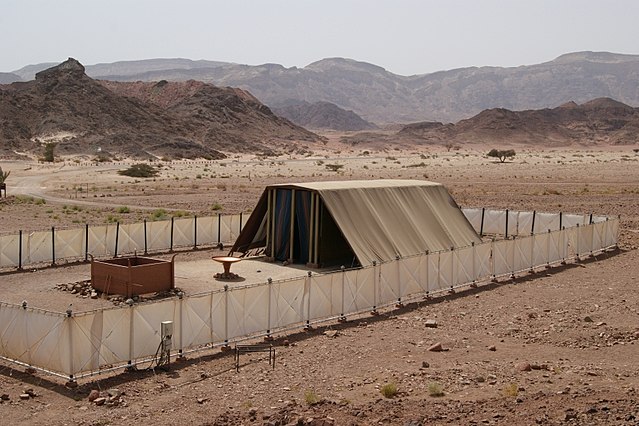
The next set of curtains over the Tabernacle after the white linen ones are the goats’ hair curtains. This second layer of curtains is often referred to as the tent.
He made curtains of goats’ hair for the tent over the tabernacle; he made eleven curtains. Exodus 36:14
Here is the full set of instructions: “You shall also make curtains of goats’ hair, to be a tent over the tabernacle. You shall make eleven curtains. 8 The length of each curtain shall be thirty cubits, and the width of each curtain four cubits; and the eleven curtains shall all have the same measurements. 9 And you shall couple five curtains by themselves and six curtains by themselves, and you shall double over the sixth curtain at the forefront of the tent. 10 You shall make fifty loops on the edge of the curtain that is outermost in one set, and fifty loops on the edge of the curtain of the second set. 11 And you shall make fifty bronze clasps, put the clasps into the loops, and couple the tent together, that it may be one. 12 The remnant that remains of the curtains of the tent, the half curtain that remains, shall hang over the back of the tabernacle. 13 And a cubit on one side and a cubit on the other side, of what remains of the length of the curtains of the tent, shall hang over the sides of the tabernacle, on this side and on that side, to cover it.” Exodus 26:7-13
There were eleven goats’ hair curtains. Eleven is the number for lawlessness, disorder, or rebellion. But why were these put over the white linen curtains of righteousness?
It all goes back to the Sin Offering rendered on the Day of Atonement, or Yom Kippur. Goats appear in all three of the Biblical feasts.
Passover — Numbers 28:16-25 – On the first day and every day of the seven-day feast of unleavened bread, God commanded special offerings.
(19) And you shall present an offering made by fire as a burnt offering to the Lord— two young bulls, one ram, and seven lambs in their first year.
There were also grain offerings and…(22) also one goat as a sin offering, to make atonement for you.
Pentecost — Leviticus 23:15-21 The same kind of distinction was placed on the goat offering made on Pentecost – The Feast of Weeks.
(19) Then you shall sacrifice one kid of the goats as a sin offering…
Tabernacles— Numbers 29:1-11 – Note that the Feast of Trumpets or Rosh Ha Shanah is the beginning of the Feast of Tabernacles
Number 29:1-2, 5 ‘And in the seventh month, on the first day of the month, you shall have a holy convocation. You shall do no customary work. For you it is a day of blowing the trumpets. 2 You shall offer a burnt offering as a sweet aroma to the Lord.
We see the same kinds of animals here along with the grain offerings. And the mention of the goat offering is also associated with sin and atonement.
(5) also, one kid of the goats as a sin offering, to make atonement for you;
God set aside the Day of Atonement for the only commanded day of fasting and repentance for the people. It falls between the Feast of Trumpets and the beginning of the Feast of Tabernacles. So, there are three specific events to the Feast of Tabernacles.
God gave instructions about the Day of Atonement, and about two goats and their role. On the Day of Atonement, the priest drew lots for two goats.
11 also one kid of the goats as a sin offering, besides the sin offering for atonement, the regular burnt offering with its grain offering, and their drink offerings.
This may sound a bit confusing. But this is how they practiced it. They killed one goat for a sin offering. They saved the other goat alive and used it as a scapegoat.
Leviticus 16:5-10 “ And he (Aaron) shall take from the congregation of the children of Israel two kids of the goats as a sin offering, and one ram as a burnt offering.
6 “Aaron shall offer the bull as a sin offering, which is for himself, and make atonement for himself and for his house (this was for the Aaron, the High Priest and the priests who served in the Tabernacle). 7 He shall take the two goats and present them before the Lord at the door of the tabernacle of meeting. 8 Then Aaron shall cast lots for the two goats: one lot for the Lord and the other lot for the scapegoat. 9 And Aaron shall bring the goat on which the Lord’s lot fell and offer it as a sin offering. 10 But the goat on which the lot fell to be the scapegoat shall be presented alive before the Lord, to make atonement upon it, and to let it go as the scapegoat into the wilderness.
(That’s the condensed Reader’s Digest version.)
The details are later in the chapter. Leviticus 16:15-22
“Then he shall kill the goat of the sin offering, which is for the people, bring its blood inside the veil, do with that blood as he did with the blood of the bull, and sprinkle it on the mercy seat and before the mercy seat. 16 So he shall make atonement for the Holy Place, because of the uncleanness of the children of Israel, and because of their transgressions, for all their sins; and so he shall do for the tabernacle of meeting which remains among them in the midst of their uncleanness. 17 There shall be no man in the tabernacle of meeting when he goes in to make atonement in the Holy Place, until he comes out, that he may make atonement for himself, for his household, and for all the assembly of Israel. 18 And he shall go out to the altar that is before the Lord, and make atonement for it, and shall take some of the blood of the bull and some of the blood of the goat, and put it on the horns of the altar all around. 19 Then he shall sprinkle some of the blood on it with his finger seven times, cleanse it, and consecrate it from the uncleanness of the children of Israel.
20 “And when he has made an end of atoning for the Holy Place, the tabernacle of meeting, and the altar, he shall bring the live goat. 21 Aaron shall lay both his hands on the head of the live goat, confess over it all the iniquities of the children of Israel, and all their transgressions, concerning all their sins, putting them on the head of the goat, and shall send it away into the wilderness by the hand of a suitable man. 22 The goat shall bear on itself all their iniquities to an uninhabited land; and he shall release the goat in the wilderness.
The blood from this goat was used for a sin offering atoned for the priesthood and the people of Israel. And it cleansed the Tabernacle.
The goats’ hair curtains were black, and were placed over the white linen ones.
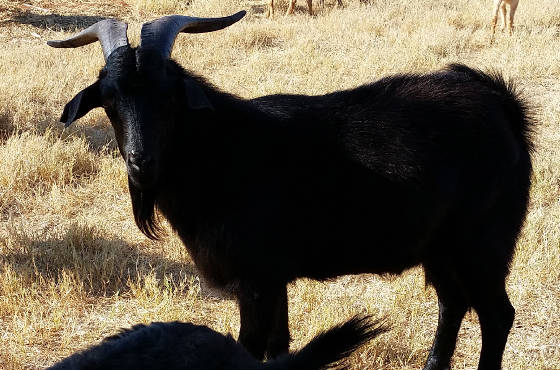
They could not be seen from the inside of the Tabernacle. These curtains represent Yeshua Ha Mashiach. He became our Sin Offering making atonement for us all.
2 Corinthians 5:21 For He made Him who knew no sin to be sin for us, that we might become the righteousness of God in Him.
Romans 8:3 For what the law could not do in that it was weak through the flesh, God did by sending His own Son in the likeness of sinful flesh, on account of sin: He condemned sin in the flesh,
Israel was diligent in keeping the feasts and making the sacrifices. But true atonement did not occur until Yeshua paid the price with His blood and life.
Do you see how important to Yahweh to reveal His Son and the sacrifice He made? Over and He wove the atonement story into the pieces of the Tabernacle.
In closing, here are three scriptures describing our Savior. Propitiation means Atonement—He traded places with us. He gave us His righteousness and took our sin and the sin of the whole world upon Himself
Hebrews 2:17 Therefore, in all things He had to be made like His brethren, that He might be a merciful and faithful High Priest in things pertaining to God, to make propitiation for the sins of the people.
1 John 2:2 And He Himself is the propitiation for our sins, and not for ours only but also for the whole world.
1 John 4:10 In this is love, not that we loved God, but that He loved us and sent His Son to be the propitiation for our sins.
There is so much more treasure here, but we’ve covered the most important things. Next time we will consider the covering of Rams Skin.
Congratulations for hanging in there. There is so much to digest.
Shalom ♥
 Hear God's Heart